- The Prohuman
- Posts
- Why are Big Techs paying Wikipedia?
Why are Big Techs paying Wikipedia?
Plus: The real meaning of Taiwan’s chip deal


Rimsha Bhardwaj, Hasan Toor & Ihtesham Haider
January 16, 2026
In partnership with

Hello, Prohuman
Today, we will talk about these stories:
Wikipedia starts charging the AI layer
A semiconductor deal with loose edges
Anthropic tries to measure real AI work
Introducing the first AI-native CRM

Connect your email, and you’ll instantly get a CRM with enriched customer insights and a platform that grows with your business.
With AI at the core, Attio lets you:
Prospect and route leads with research agents
Get real-time insights during customer calls
Build powerful automations for your complex workflows
Join industry leaders like Granola, Taskrabbit, Flatfile and more.
Wikipedia turns reuse into revenue

Image Credits: Wikipedia
Wikipedia finally put a meter on AI reuse.
The Wikimedia Foundation announced new AI partnerships with Amazon, Meta, Microsoft, Perplexity, and others through Wikimedia Enterprise, its paid data product. Wikipedia remains a top-10 global website, serving over 65 million articles in 300 languages, viewed nearly 15 billion times per month.
This is less about celebration and more about survival as AI products increasingly summarize Wikipedia instead of sending traffic back. Sitting at a laptop early in the morning, this looks like a pragmatic move to make large AI companies pay for speed, scale, and reliability rather than scrape for free.
It formalizes a market where foundational knowledge is licensed infrastructure, not just a public good. Smaller AI teams may feel the cost, while big platforms quietly lock in cleaner access to one of the internet’s most trusted sources.
The open question is how long free access and paid access can coexist
A big number with fuzzy terms

Image credits: Reuters
The headline number is clean. The details are not.
Taiwanese semiconductor and tech companies agreed to invest $250 billion into U.S. semiconductor, energy, and AI production under a deal announced by the Commerce Department. Taiwan will also provide another $250 billion in credit guarantees, while the U.S. pledged reciprocal investment in Taiwan without naming a dollar amount or timeline.
This reads less like a construction plan and more like a strategic signal tied to trade talks and upcoming tariffs. At 10% domestic chip production today, the U.S. needs foreign capital badly, and this deal lets the administration say progress is underway even if the checks land slowly, sometime after the press conference lights shut off.
If the investments materialize, they help de-risk supply chains and soften the impact of new semiconductor tariffs. If they stall, the policy still tightens pressure on other chip-producing countries to come to the table.
The real test will be whether factories appear, not just figures.
AI helps hardest tasks first
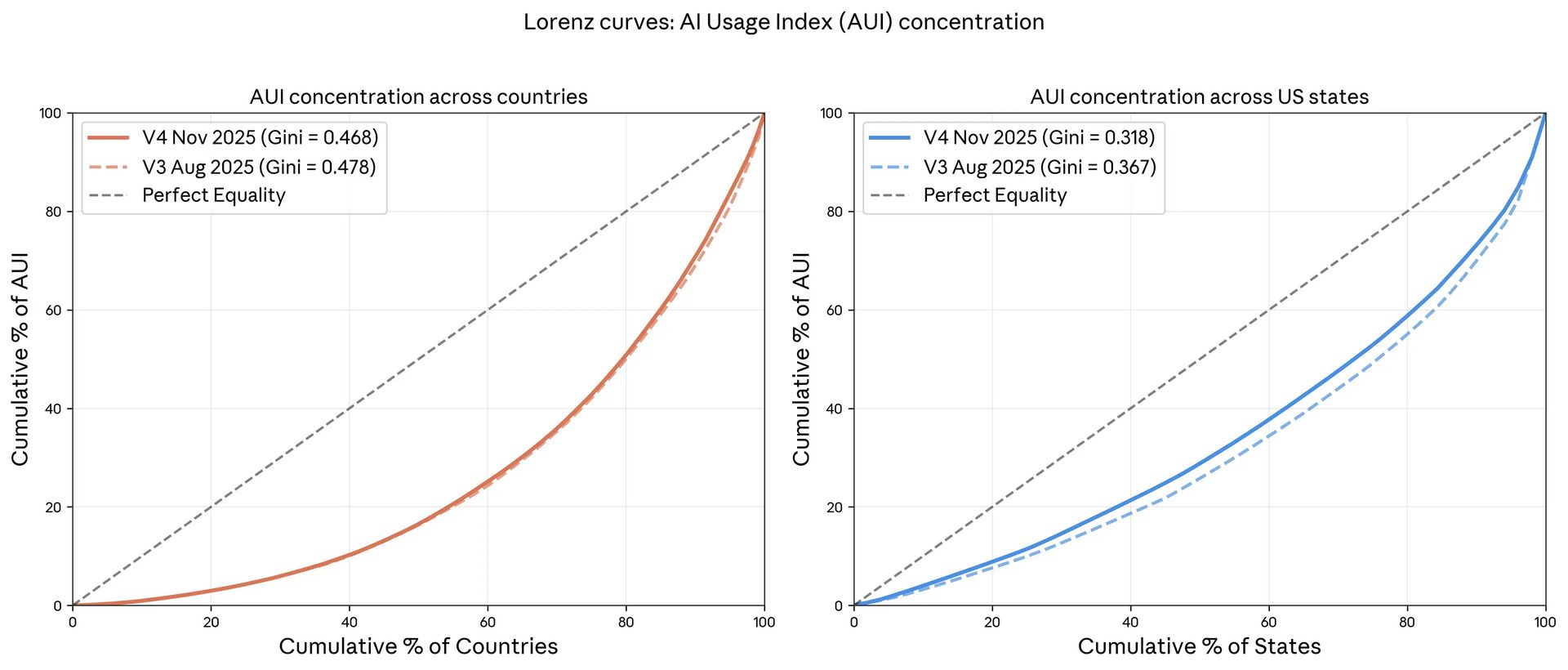
Image Credits: Anthropic
Anthropic is trying to quantify AI work, not hype it.
The company released a new Economic Index based on 2 million Claude conversations from November 2025, split between consumer use and its business API. It introduces five “economic primitives” that track task complexity, skill level, autonomy, purpose, and success, then uses them to estimate productivity effects.
The most important finding is that Claude speeds up complex, high-skill tasks far more than simple ones, with college-level tasks seeing roughly a 12x speedup versus 9x for high school level work. Sitting at a desk late in the afternoon, that lines up with how white-collar workers actually use AI today, as a force multiplier for thinking-heavy tasks rather than a replacement for routine labor.
Once success rates are factored in, estimated U.S. productivity gains fall from 1.8 points to about 1.0 to 1.2 per year, which feels more realistic. It also hints at short-term deskilling, since AI currently touches higher-education tasks first.
The data is careful, but it still raises the same question: what happens when reliability catches up to speed?
Prohuman team
Covers emerging technology, AI models, and the people building the next layer of the internet. |  Founder |
Writes about how new interfaces, reasoning models, and automation are reshaping human work. |  Founder |
Free Guides
Explore our free guides and products to get into AI and master it.
All of them are free to access and would stay free for you.
Feeling generous?
You know someone who loves breakthroughs as much as you do.
Share The Prohuman it’s how smart people stay one update ahead.